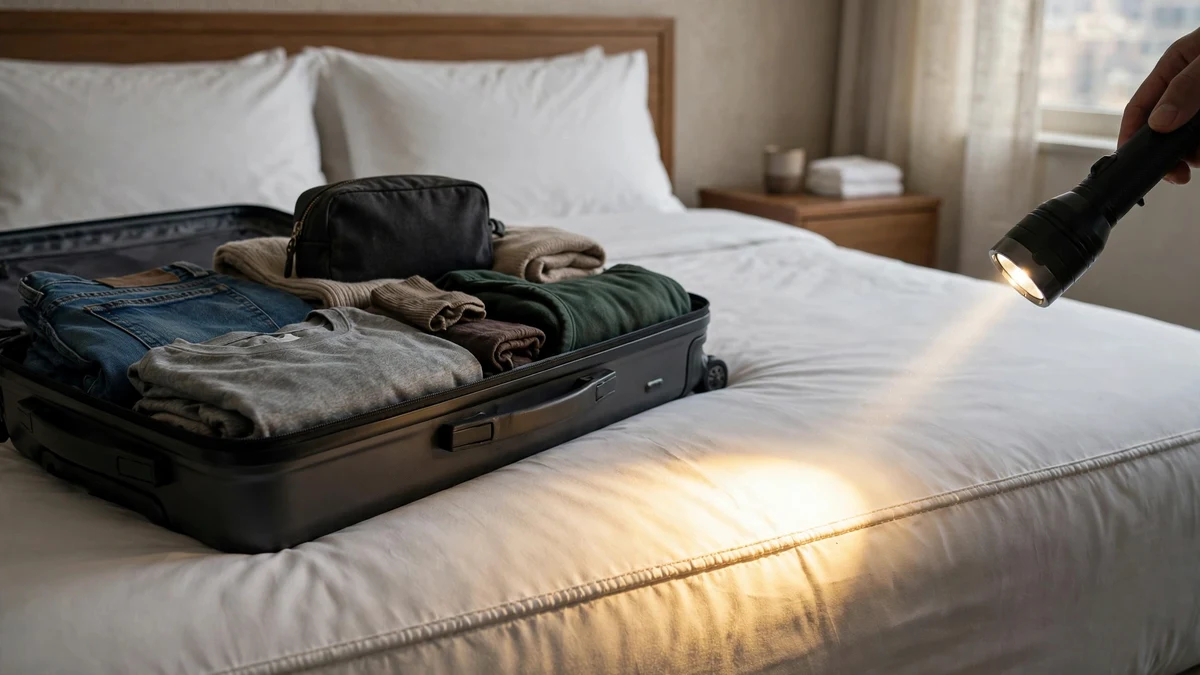
Here is the core fact that unlocks everything else about bed bug spread: bed bugs crawl; they do not fly, jump, or glide. They have no wings and no jumping legs. On their own, they are slow, short-range crawlers that prefer to stay within a few feet of a sleeping host. Every long-distance move a bed bug ever makes happens because a human carried it — in luggage, on furniture, in a laundry bag — without knowing.
In short: bed bugs spread by hitchhiking on belongings, not by living on people. Travel and luggage are the number-one vector, followed by used furniture and migration between units in apartment buildings. They do not spread person-to-person like lice. Prevention means inspecting what comes into your home, not avoiding people.
How Do Bed Bugs Move?
Because the biology sets the limits, start there. An adult bed bug is a flat, wingless crawler about the size of an apple seed. Under its own power it can crawl respectable distances — the CDC notes they can travel over a hundred feet in a night — but in practice they rarely bother: a bed bug's entire survival strategy is staying close to a reliable blood meal, which means staying close to where you sleep.
This is why "spread" in bed bugs almost never means the bugs marched across town. It means a pregnant female or a few stowaways rode in something you carried — a suitcase from a hotel, a used nightstand, a laundry bag from a shared facility — and founded a new population at the destination. Human transport is fast, far, and invisible; the bugs' own crawling is slow, short, and local. Every prevention strategy below targets one side or the other of that divide.
What Are the 7 Ways Bed Bugs Spread?
Ranked roughly by how often each vector starts new infestations, based on what pest professionals actually see:
1. Travel and luggage — the number-one vector
Hotels, motels, vacation rentals, and even high-end properties host bed bugs because of guest turnover, not cleanliness. A bug crawls into a suitcase seam or a folded jacket in one city and crawls out in yours. Dalton's position on the I-75 corridor means constant traveler flow — and constant introduction risk. The two-minute hotel inspection (luggage in the bathroom, check mattress seams and headboard with a flashlight) blocks most of this vector.
2. Used furniture and mattresses
Curb finds, thrift-store scores, and hand-me-down mattresses are classic introduction routes. Bed bugs and their eggs hide in joints, screw holes, and under upholstery where a quick visual check misses them. Any secondhand sleeping or sitting furniture deserves a seam-by-seam flashlight inspection before it crosses your threshold — and ideally, heat treatment of fabrics.
3. Multi-unit migration
In apartments, condos, and duplexes, bed bugs travel through wall voids, along pipes and conduits, under doors, and through shared electrical outlets. One heavily infested unit can seed its neighbors without anyone moving a thing. This is the vector where individual action is weakest — it takes building-level coordination, which is why multi-unit bed bug jobs are managed differently from single-family ones.
4. Shared laundry facilities
Laundromats and shared laundry rooms bring everyone's belongings into contact. Bugs transfer between bags, hampers, and folding tables. The fix is procedural: transport laundry in sealed bags, move clothes directly from dryer to sealed bag (dryer heat kills all life stages), and never set bags down on shared surfaces longer than necessary.
5. Moving infested items between rooms — or homes
Dragging a suspect mattress to the guest room, lending an infested chair to a relative, or moving out of an infested apartment without treating belongings first all convert a contained problem into a distributed one. This is the most self-inflicted vector on the list: the instinct to "get it out of here" is exactly what spreads them. Contain first, treat second, move last.
6. Visitors' belongings
Overnight guests bring luggage, and luggage can bring bed bugs — from their home, their hotel en route, or anywhere their bag sat. This is not a reason to interrogate your guests; it is a reason to have a guest-room inspection habit and to store guest luggage on racks away from beds and upholstered furniture.
7. Workplace and school transfer
Less common but real: bugs hitchhike in bags, coats, and lockers, then ride home again. Offices with shared coat areas and schools with cubbies see occasional transfer. Keeping bags off shared upholstered surfaces and doing periodic bedroom checks catches these introductions early — which is the entire theme of our early detection guide.
How Fast and Far Can They Spread?
Because "spread" means two very different things — the bug's own crawling versus human-assisted transport — this table keeps them separate:
| Vector | Distance | Speed | Prevention |
|---|---|---|---|
| Own crawling (within a home) | Room to room; 100+ feet/night possible | Slow — weeks to colonize adjacent rooms | Early detection; do not move infested items |
| Luggage / travel | City to city, state to state | As fast as you travel | Hotel inspection; luggage protocols |
| Used furniture | Neighborhood to neighborhood | Single trip | Inspect before bringing inside |
| Multi-unit migration | Unit to adjacent units via voids/conduits | Weeks to months | Building coordination; seal penetrations |
| Shared laundry | Within a building | Single wash-day cycle | Sealed bags; dryer heat; minimal surface contact |
| Moving infested items | Room to room, home to home | Single move | Treat before moving; wrap and seal |
The pattern is clear: the fastest, farthest spread is always human-assisted, which means it is also the most preventable. When infestations seem to "explode" quickly, what actually happened is usually a slow local buildup that went unnoticed — satellite colonies form when crowded conditions push bugs outward — followed by sudden discovery, not sudden spread.
Spotted something on this list? bed bug treatment in Dalton starts with a professional inspection — we will tell you plainly what we find and what it takes to fix it.
Can Bed Bugs Spread From Person to Person?
Because this myth drives real anxiety — people avoiding hugs, declining invitations, worrying about a handshake — here is the definitive correction: bed bugs do not live on human bodies. Unlike lice, which cling to hair and skin, bed bugs feed and then retreat to harborages in the environment: mattress seams, bed frames, baseboards. Direct person-to-person contact does not spread them.
What does spread them between people is indirect: your coat draped over an infested chair, your bag set on an infested bed, your laptop bag in an infested locker. The CDC's framing is precise — bed bugs are transported on belongings, not bodies. You cannot "catch" bed bugs from someone the way you catch a cold; you can only pick up their hitchhikers from their environment. Keep the distinction straight and the fear stays proportional to the facts.
One related question we hear constantly: can bed bugs live in your hair? No. They may crawl across skin and hair while seeking a feeding site, but they do not infest hair, lay eggs there, or colonize scalps. If something is living in hair, it is not bed bugs — see a medical professional or consider lice, which are a different pest entirely.
How Do Bed Bugs Spread in Apartment Buildings?
Because multi-unit buildings combine many hosts with shared infrastructure, they are the hardest bed bug environments to manage — and the dynamics are worth understanding even if you own a single-family home, since the same principles apply to duplexes and condos.
Bed bugs move between units through wall voids, along plumbing and electrical conduits, under doors, and across shared hallways on belongings. A heavily infested unit becomes a source population that steadily seeds its neighbors; treating one unit while the source unit goes untreated is the classic recipe for recurring "reinfestation" that was really continuous migration. Effective multi-unit work therefore requires coordination: inspection of adjacent units (above, below, and beside), simultaneous treatment where activity is found, and honest communication between residents and management. If you rent, reporting promptly is not just good citizenship — it is self-protection, because the bugs do not respect unit boundaries.
How Do You Stop Bed Bugs From Spreading?
Because each vector has its own block, prevention is a set of habits rather than a single product. The travel protocol matters most: inspect hotel rooms before settling in (mattress seams, headboard, nightstand — two minutes with a flashlight), keep luggage on racks or in the bathroom rather than on the bed, and when you get home, run travel clothes through a hot dryer and inspect the suitcase before storing it.
For secondhand furniture, the rule is inspect-before-entry: seam-by-seam flashlight check of any used bed, couch, or chair, with heat treatment of fabrics as the gold standard. In apartments, do a move-in inspection of bedrooms before your furniture arrives, report signs immediately, and push for building-level response rather than solo treatment. Mattress encasements on every bed in the house remove the bugs' favorite harborage and make future inspections dramatically easier — see the EPA's bed bug guidance at epa.gov/bedbugs for the federal overview of these methods.
What If Bed Bugs Have Already Spread Through Your Home?
Because multi-room infestations need a different plan than single-seam introductions, the first step is a professional inspection that maps the full extent — which rooms, which harborages, how far the satellite colonies reach. Bed bug treatment in Dalton starts there, because the treatment design follows the map: localized heat or targeted applications for contained activity, whole-home protocols when the bugs have spread.
Before the visit, our home preparation checklist covers the bed-bug-specific prep that makes treatment more effective — high-heat laundry, decluttering around beds, and bed isolation — and our early detection guide is worth a re-read so you can monitor for stragglers after treatment. The spread stops when the source population is eliminated; everything before that is containment.
Ready for a straight answer about your home? bed bug treatment in Dalton — call, message, or request a free estimate and we will take it from there.