Call +1 (647) 367-1424 WhatsApp Us Request an Inspection
Rodent control in Dalton, GA is the inspection, trapping, and permanent exclusion of mice and rats from homes across Whitfield County - and in Northwest Georgia, it is a fall-driven battle. As nights cool, rodents move from fields, wooded lots, and crawl spaces into the warmth of our homes, and Dalton's mix of older crawl-space houses and newer subdivisions backing to woods gives them plenty of doors. We are Dalton Pest Pros, and rodent work is where we earn trust: anyone can set a trap, but only exclusion keeps them out for good.
In short: House mice, Norway rats, roof rats, and deer mice each enter and behave differently, so identification drives the plan. We inspect the full exterior, attic, and crawl space, remove the active population with trapping, then seal every entry point with rodent-proof materials - because without exclusion, new rodents simply move into the same openings. This page covers species, signs, entry points, methods, and prevention for Dalton homes.
Which Rodents Invade Dalton Homes?
Because different rodents use different entry routes and respond to different control strategies, we identify the species before we do anything else. Four rodents account for nearly every infestation we see in the Dalton area.
House mice
The house mouse (Mus musculus) is the most common indoor rodent in North Georgia and the one behind most "scratching in the walls" calls. Adults are 2 to 4 inches long plus tail, gray-brown, with large ears and pointed snouts. Their defining trait is flexibility: a house mouse squeezes through a gap as small as one-quarter inch - roughly the width of a pencil. They nest in wall voids, cabinets, and storage areas, breed rapidly, and travel along established runways they mark with scent.
Norway rats
The Norway rat (Rattus norvegicus) is the heavyweight: 7 to 10 inches long plus tail, brown and stocky, a burrower that enters low. Norway rats dig under foundations, slip through ground-level gaps, and nest in crawl spaces, basements, and under slabs. Their droppings are blunt-ended capsules about three-quarters of an inch long. Where house mice are nibblers, Norway rats are gnawers - and their gnawing damages wiring, pipes, and structure.
Roof rats
The roof rat (Rattus rattus) is the climber: slender, dark, with a tail longer than its body. True to the name, roof rats enter at the roofline - through soffit gaps, roof vents, uncapped chimneys, and branches touching the roof - and nest in attics and upper wall voids. Scratching overhead at night in a Dalton ranch home is the classic roof rat signature. They are excellent climbers and poor burrowers, which is the inverse of the Norway rat.
Deer mice in wooded areas
Deer mice (Peromyscus species) live in the woods and fields around Whitfield County and move into outbuildings, garages, and cabins - especially homes on wooded lots near Rocky Face or the ridges east of town. They are handsome mice with white bellies and bicolored tails, but they carry a serious note: deer mice are the primary reservoir for hantavirus, shed in their droppings and urine. Deer mouse droppings should never be swept dry - the CDC guidance below explains the safe cleanup.
What Are the Signs of a Rodent Infestation?
Rodents are nocturnal and secretive, so infestations are diagnosed from sign, not sightings. Because each species leaves different evidence, the signs also tell us which rodent we are dealing with before we ever see one.
Droppings - what size tells you
Droppings are the single most reliable diagnostic. House mouse droppings are small - about one-quarter inch, pointed at both ends, like grains of rice. Norway rat droppings are blunt-ended capsules around three-quarters of an inch. Roof rat droppings are similar in length but more curved and pointed. Fresh droppings are dark and soft; old ones are gray and crumbly. Where droppings concentrate along a wall or beam, you have found a runway - and runways tell us where to place traps and where to look for entry points.
Gnaw marks and rub marks
Rodent teeth never stop growing, so rodents gnaw constantly: on wood, plastic, wiring insulation, and even soft metals. Fresh gnaw marks are light-colored; old ones darken. Rub marks are the dark, greasy smudges rats leave where their oily fur repeatedly contacts a surface - along baseboards, beams, and pipe runs. Mice rarely leave visible rub marks; prominent rub marks point to rats.
Noises - when and where as species clues
Sound plus timing identifies the animal. Light scratching and scampering in walls at night suggests mice. Heavier thumping and gnawing overhead at night suggests roof rats in the attic. Daytime scurrying overhead points to squirrels instead - see our wildlife in the attic guide and our Dalton wildlife removal page for that distinction. Scratching under the floor points to crawl space activity, often Norway rats or mice.
How Do Mice and Rats Get Inside?
Every rodent infestation has an entry story, and finding it is the difference between control and permanent exclusion. Our rodent entry points guide catalogs these in detail; the four categories below cover what we find on Dalton inspections.
Ground-level gaps
Foundation cracks, gaps where siding meets the foundation, crawl space vents with missing or rusted screens, and daylight visible around the sill plate. Mice need only a quarter inch; rats need about a half inch. We check the entire foundation perimeter on foot, because the entry is often on the side of the house nobody looks at.
Roofline and attic entries
Soffit gaps, gable vent screens, roof-to-wall junctions, and fascia boards chewed or rotted open. Roof rats and mice both use these, and so do squirrels - which is why attic-entry jobs sometimes cross over into wildlife removal. Any tree branch touching the roof is a rodent highway and gets noted for trimming.
Utility and pipe penetrations
Where pipes, conduits, cables, and HVAC lines pass through walls and foundations, the openings are frequently oversized and unsealed. Dryer vents, exterior faucets, and the gaps around AC line sets are classic entries. These are also the penetrations mice use to move between rooms once inside.
Garage doors
Worn or missing weatherstripping along the bottom and sides of garage doors leaves exactly the gap a mouse needs, and attached garages give rodents a sheltered staging area before they push into the house proper. Door sweeps and intact seals close this route.
Why Is Fall the Worst Season for Rodents in Dalton?
Rodent pressure in North Georgia follows the temperature curve. As nights cool in October and November, the fields and woods around Whitfield County offer less food and less warmth, and rodents do the rational thing: move indoors. Harvest activity in surrounding farmland displaces field populations, fallen leaves provide cover for their approach, and Dalton's large stock of vented crawl-space homes offers ideal harborage - dark, sheltered, and full of entry points at ground level.
This is also why fall is the right season for exclusion work. Sealing entry points in October closes the doors before the peak invasion; waiting until you hear scratching in December means trapping an established indoor population first. If you are reading this in fall and have never had your home's exterior sealed, that timing is not a coincidence - it is the single highest-value rodent service a Dalton homeowner can buy.
What Happens During a Rodent Inspection?
Because rodents use the whole structure - foundation to roofline - our inspection covers the whole structure, in the same order every time.
- Exterior perimeter. Full walk-around at ground level: foundation, vents, utility penetrations, garage doors, and grading that gives rodents cover against the house.
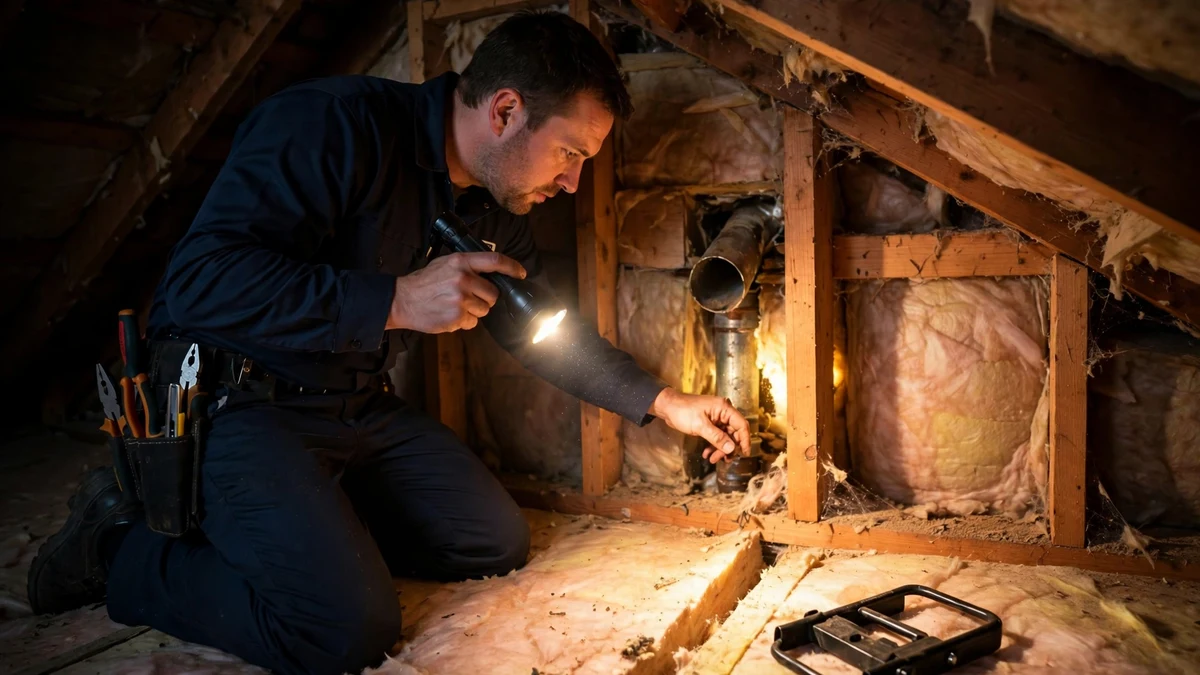
- Roofline and attic. Soffits, vents, and roof junctions from outside; then the attic itself with a bright light - droppings, nesting material, gnawed wiring, and entry gaps at the eaves.
- Crawl space. Piers, sill plates, subflooring, and plumbing penetrations - the Norway rat and house mouse zone.
- Interior and droppings mapping. Kitchens, pantries, garages, and storage areas. We map where droppings concentrate, because runways determine trap placement and point back to the entries that matter most.
Which Rodent Control Method Works Best?
Three tools exist - trapping, baiting, and exclusion - and they are not interchangeable. The table below is the honest comparison we use with customers, including the method most companies skip because it is labor-intensive.
| Method | How it works | Speed | Permanence | Best for |
|---|---|---|---|---|
| Trapping | Snap traps, live traps, and multi-catch devices placed on active runways; checked and reset on a schedule | Fast - removes active rodents within days | Temporary alone - new rodents enter through the same gaps | Removing the current indoor population; situations where poison is inappropriate |
| Baiting | Tamper-resistant bait stations placed outside; rodents feed and the population declines | Slower - days to weeks | Temporary alone - does not close entries | Exterior population pressure; commercial settings; where trapping the interior is impractical |
| Exclusion | Sealing every entry point with rodent-proof materials so new animals cannot get in | Not a removal method - paired with trapping | Permanent - the only fix that lasts | Every rodent job - the step that makes the other two stick |
In short: Trapping removes the rodents you have; baiting reduces pressure from outside; exclusion - sealing every entry with materials rodents cannot chew through - is the only permanent fix. Any plan that skips exclusion is a plan to repeat the job next fall.
What Is Exclusion - and Why Is It the Only Permanent Fix?
Exclusion is the systematic sealing of every rodent entry point on the structure, and it is the step that separates professional rodent control from endless re-trapping. Rodents do not respect property lines or seasons; as long as the openings exist, new animals will find them. Close the openings with the right materials, and the cycle ends.
Materials matter more than effort. We seal with steel wool or copper mesh packed into gaps and sealed over with caulk or cement, quarter-inch hardware cloth over vents and larger openings, metal flashing at roofline gaps, and brush-style door sweeps on garage and exterior doors. What we do not use is spray foam alone: rodents chew through cured foam in minutes, and a foam-plugged hole is a hole with a "welcome" sign. Foam has a place as a backing and air seal behind real exclusion materials - never as the barrier itself.
The method is as important as the materials: seal from the outside where possible, work top to bottom so you do not trap animals inside wall voids, and verify with a final walk-around. Done correctly, exclusion is a one-time investment that pays for itself the first fall it prevents an invasion.
What Health and Property Risks Do Rodents Pose?
We keep this section factual, because the real risks are serious enough without exaggeration. Rodents contaminate food and food-contact surfaces with droppings and urine wherever they travel - pantries, countertops, and pet food bowls. They gnaw constantly, and gnawed electrical wiring is a genuine fire risk: it is one of the most common ways rodents damage homes beyond the nuisance level. Insulation in attics and crawl spaces gets compressed, tunneled, and contaminated, losing its thermal value. And deer mice in our wooded areas are the hantavirus reservoir - the CDC's guidance is clear that their droppings should be wetted with disinfectant and wiped up, never swept or vacuumed dry, which aerosolizes the virus. These are the stakes that make professional rodent work worth doing right.
How Do You Keep Rodents Out After Treatment?
After trapping and exclusion, sanitation determines whether your home stays unattractive to the next dispersing rodent. Store dry goods and pet food in sealed hard containers - mice chew through bags and cardboard effortlessly. Take garbage out on schedule and keep cans lidded and clean. Fix plumbing leaks; rodents need water daily. Outside, reduce harborage: move woodpiles away from the house, clear leaf litter and dense ground cover against the foundation, and trim vegetation back from the walls. None of this replaces exclusion, but a sealed home with nothing to eat is a home rodents pass by.
What Affects the Cost of Rodent Control?
Rodent jobs vary more than almost any other pest service, so we quote per job after inspection. The factors: how large the infestation is and which species (a few mice versus an established rat population are different jobs), how many entry points need sealing and the linear footage of exclusion work, whether the attic or crawl space needs access and cleanup, and how many follow-up visits the trapping phase requires. Our cost estimator page explains how we build a quote - and why exclusion, though the largest line item, is the one that ends the recurring expense.
Rodent Control Across Dalton and Whitfield County
We provide rodent inspection, trapping, and exclusion throughout Dalton and Whitfield County - including Calhoun, Ringgold, and Tunnel Hill - with our full service area covering the rest. If you are hearing scratching, finding droppings, or just want the doors closed before fall, call +1 (647) 367-1424, message us on WhatsApp, or request an inspection. For the full picture of our pest control in Dalton, GA, start at the home page.