Every pest control company sells a quarterly plan, and every one of them will tell you it is worth it. That unanimity should make you skeptical — not of the service, but of the sales pitch. So here is the breakdown without the pitch: what quarterly service is, the science behind the schedule, where the value actually comes from, and the honest cases where you should buy more, less, or something different entirely.
In short: quarterly pest control means four preventive visits a year, mostly treating the home's exterior to keep pests from getting inside. The three-month cadence exists because professional products break down in roughly 60–90 days of sun, rain, and irrigation. It is worth it for homes with regular pest pressure; it is not enough for active infestations or heavy-pressure properties; and it can be overkill for well-sealed, low-pressure homes.
What Does Quarterly Pest Control Actually Include?
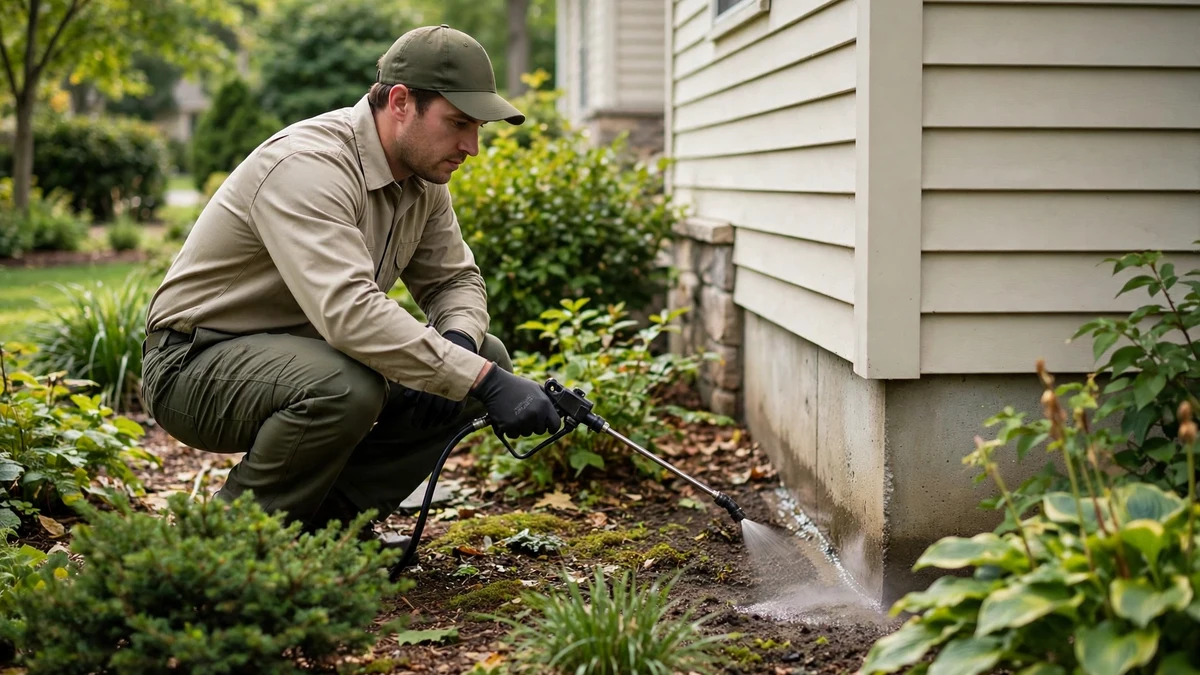
Because "quarterly service" sounds vague until you see a visit, here is what the four visits a year typically involve. The core of each visit is the exterior barrier: treatment of the foundation perimeter, around doors and windows, eaves and soffits, and other entry points — the goal being to stop pests before they get inside rather than fighting them after. Interior treatment happens on request or when there is interior activity to address; the modern standard is exterior-focused with interior as needed.
A standard visit also includes inspection: the technician walks the property looking for new conducive conditions, fresh pest evidence, and changes since the last visit — a wasp nest starting under the eaves, ants trailing to a new entry, moisture issues developing. De-webbing of eaves and removal of visible nests are typical. The visit usually takes well under an hour for an average home, and for exterior-only service you generally do not need to be home. Four of these a year, spaced roughly three months apart, is the quarterly plan.
Why Every Three Months?
Because the cadence looks arbitrary, here is the chemistry behind it: professional pest control products are designed to leave a residual — an active deposit on treated surfaces that keeps killing or repelling pests for weeks after application. But residuals are not permanent. Sunlight (UV breakdown), rain, and irrigation degrade them steadily, and in real-world conditions the effective life of a typical exterior residual is roughly 60 to 90 days.
The quarterly schedule is simply the re-application rhythm that matches the product's lifespan: treat, let the residual work for two to three months, re-treat before protection gaps open. Stretch the interval much longer and you get unprotected weeks where pests re-establish; tighten it to monthly without a reason and you are paying for overlapping protection you do not need. The three-month cadence is not a marketing invention — it is the maintenance interval the chemistry dictates. (Heavy rain periods and irrigated beds can shorten residual life, which is one reason technicians sometimes adjust timing seasonally.)
How Does Quarterly Service Match Georgia's Pest Seasons?
Because Northwest Georgia has distinct pest seasons rather than a single pest season, each quarterly visit naturally targets what is active — which is a large part of the plan's value here:
Spring visit: termite swarm season and ant emergence. The inspection focuses on swarm evidence, mud tubes, and the ant trails that start with the first warm weeks. This is the highest-stakes visit of the year in termite-belt Georgia.
Summer visit: mosquitoes, ants at peak, wasps and hornets nesting. Exterior barrier work is heaviest, harborage reduction matters most, and mosquito pressure gets assessed (note: mosquitoes on a quarterly cadence get suppression, not control — more below).
Fall visit: overwintering invaders — the annual migration indoors. Rodents, spiders, crickets, ladybugs, and stink bugs all seek winter shelter; the fall visit is about exclusion support and intercepting them at the perimeter before they settle in for winter.
Winter visit: rodent pressure peaks as cold drives mice and rats toward structures, and the inspection focuses on entry points, attic and crawl-space activity, and stored-product pests. In Georgia's mild winters, some insect activity continues, so the visit is far from a formality.
This seasonal alignment is why quarterly beats a single annual treatment in Georgia: one visit cannot cover four different pest seasons.
Spotted something on this list? pest control in Dalton in Dalton, GA starts with a professional inspection — we will tell you plainly what we find and what it takes to fix it.
When Does Quarterly Service Pay Off?
Because "worth it" is a value question, here is the value structure without numbers. The core comparison is preventive cadence versus emergency one-offs: four scheduled visits that catch problems small, against the pattern of ignoring pests until something forces a call — at which point the infestation is established, the treatment is intensive, and the disruption is maximal. Prevention does not just cost differently; it fails differently. A missed ant trail in April is a five-minute fix on the spring visit; the same trail ignored until August is a kitchen infestation.
The second value driver is early detection as a built-in feature: a trained technician walking your property four times a year will spot the termite mud tube, the wasp nest starting under the eave, the moisture issue behind the shrubs — the things homeowners walk past. Third, ask any company — including us — what happens between scheduled visits if a problem flares up: some plans include re-service visits at no additional charge, some do not, and the real policy (in writing) is part of what you are evaluating. Our cost factors guide covers how to compare these policies fairly.
When Is Quarterly NOT Enough?
Because honesty requires the other side, quarterly service has clear limits. Heavy-pressure properties — homes backing to woods, water, or farmland, where the pest reservoir is effectively infinite — often need more frequent attention than four visits a year. Active infestations are not a quarterly-service problem at all: an established German roach population, a bed bug infestation, or an active termite colony needs intensive corrective treatment first, with quarterly service as the maintenance layer afterward. Starting a quarterly plan on top of an active infestation is like starting a fitness plan during a medical emergency — wrong tool, wrong time.
German roaches specifically need a dedicated program, not a general quarterly barrier — they live and breed indoors, where exterior treatments barely reach them. Mosquito-primary needs exceed the quarterly cadence: effective mosquito suppression runs every three to four weeks through the season, because mosquito generations turn over far faster than quarterly visits. If mosquitoes are your main complaint, you need mosquito control in Dalton on its own schedule, not a quarterly plan with mosquito hopes attached.
When Might Quarterly Be Overkill?
Because a pest company telling you when not to buy is how trust is built: some homes genuinely do not need quarterly service. Newer, well-sealed homes with intact exclusion, no conducive conditions, and no history of pest issues are low-pressure environments — a thorough one-time treatment plus an annual inspection may cover them completely. Homes in low-pressure settings — no wooded lot, no water features, no prior infestations, diligent sanitation — similarly may not generate enough pest activity to justify four visits.
The honest test: if two consecutive quarterly visits find nothing — no activity, no evidence, no conducive changes — ask whether the cadence still fits, or whether stepping down to twice-yearly or as-needed service makes more sense. A company that argues against its own recurring revenue when the evidence supports stepping down is a company you can trust when it argues the reverse.
How Do You Decide What's Right for Your Home?
Because the decision is situational, run this checklist:
- Property: wooded/water/farmland backing (higher pressure) vs. open, well-drained lot (lower)? Crawl space or slab? Acreage or compact lot?
- History: recurring ant, spider, or roach issues? Prior termite activity? Any current active infestation (which needs corrective treatment first)?
- Exclusion state: is the home well-sealed, or are there known entry points and conducive conditions?
- Tolerance: how much pest activity is acceptable to you between visits? Zero-tolerance households value the cadence more.
- Specialty pests: do you need termite, bed bug, mosquito, or wildlife coverage — all of which sit outside standard quarterly plans (termites especially; see our Dalton termite treatment page)?
Note that last point carefully: standard quarterly plans typically cover general household pests — ants, spiders, crickets, occasional invaders — while termites, bed bugs, mosquitoes, and wildlife are usually separate programs. One of the most common disappointments in the industry is a homeowner discovering, mid-termite-swarm, that their quarterly plan never covered termites. Ask explicitly what is not covered before you sign anything.
To put numbers-free structure around the decision, our cost estimator walks through your situation factor by factor, and our DIY vs. professional guide helps with the adjacent question of what to handle yourself. Or skip the research and contact us — tell us about your property and we will tell you plainly whether quarterly fits.
Ready for a straight answer about your home? pest control in Dalton — call, message, or request a free estimate and we will take it from there.